
Table of Contents
Case Title
Shaileshbhai Govindbhai Makwana v. State of Maharashtra
Introduction
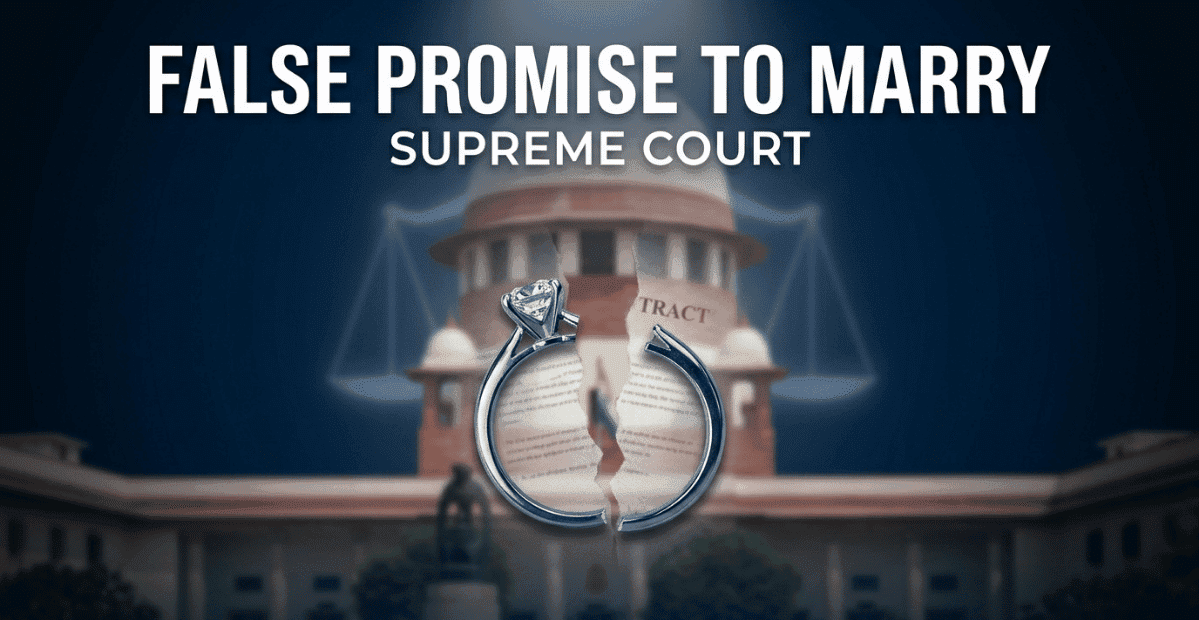
The Supreme Court examined whether a long consensual relationship can later be termed rape on the ground of a false promise of marriage.
The Court held that where parties knowingly maintain a relationship over several years, it cannot be treated as rape merely because the relationship later fails.
Thus, the Court clarified the distinction between a false promise and a breach of promise to marry.
Factual Background
The complainant was earlier married and lived separately from her husband since 2012. Before her divorce was finalised, she created a matrimonial profile in 2017.
The appellant contacted her through the matrimonial platform. They developed a relationship and remained in contact through calls and meetings.
In October 2017, the appellant visited her and stayed for a few days. The complainant alleged that he established physical relations on the promise of marriage.
However, the record showed that:
- The parties continued the relationship for about four years
- They travelled together and stayed in hotels
- They maintained a physical relationship repeatedly
- No complaint was filed during this period
The complaint was filed only in February 2021 after the appellant refused to marry her.
Also Read:
UGC NET Law: Negligence under Law of Torts – Complete Notes https://legalpaathcoaching.com/ugc-net-law-notes-negligence-law-of-torts/
Core Legal Issue
Whether a prolonged consensual relationship can be treated as rape on the ground of a false promise of marriage.
Supreme Court’s Analysis
The Court analysed the conduct of both parties and the timeline of events.
It noted that both parties knew about each other’s prior marriages. The complainant entered the relationship even before her divorce was finalised.
Further, the Court found that the relationship continued voluntarily for four years. During this time, the complainant never raised any allegation of force.
Therefore, the Court concluded that the relationship was consensual and not based solely on a false promise.
False Promise vs Breach of Promise
The Court relied on Mahesh Damu Khare v. State of Maharashtra and clarified:
- A false promise exists when there was never any intention to marry from the beginning
- A breach of promise occurs when circumstances later prevent marriage
The Court also referred to Naim Ahamed v. State (NCT of Delhi) and held that not every failed relationship amounts to rape.
Key Observations
- The parties cohabited voluntarily from 2017 to 2020
- The complainant continued the relationship without objection
- No complaint of force was made for four years
- The dispute arose only after refusal to marry
Thus, the Court held that consent was not obtained through misconception of fact.
Error by the High Court
The Supreme Court held that the High Court erred in refusing to quash the proceedings.
It wrongly treated the matter as requiring trial despite clear facts showing a consensual relationship.
Final Decision
The Supreme Court:
- Quashed RCC No. 328/2021
- Set aside the High Court’s order
- Discharged bail bonds
Conclusion
The judgment clarifies an important principle in criminal law. A consensual relationship over a long period cannot later be converted into a rape case merely due to a failed promise of marriage.
Thus, courts must carefully distinguish between genuine deception and a breakdown of a relationship.
Also Read:
UGC NET Law: Defamation under Law of Torts – Complete Notes https://legalpaathcoaching.com/ugc-net-law-notes-defamation-law-of-torts/

[…] Also Read:False Promise to Marry and Rape – Supreme Court Judgment Explained https://legalpaathcoaching.com/false-promise-to-marry-rape/ […]
[…] Also Read:False Promise to Marry and Rape – Supreme Court Judgment Explained https://legalpaathcoaching.com/false-promise-to-marry-rape/ […]