Table of Contents
State of Kerala v. K.A. Abdul Rasheed
Citation: 2026 INSC 365
Introduction
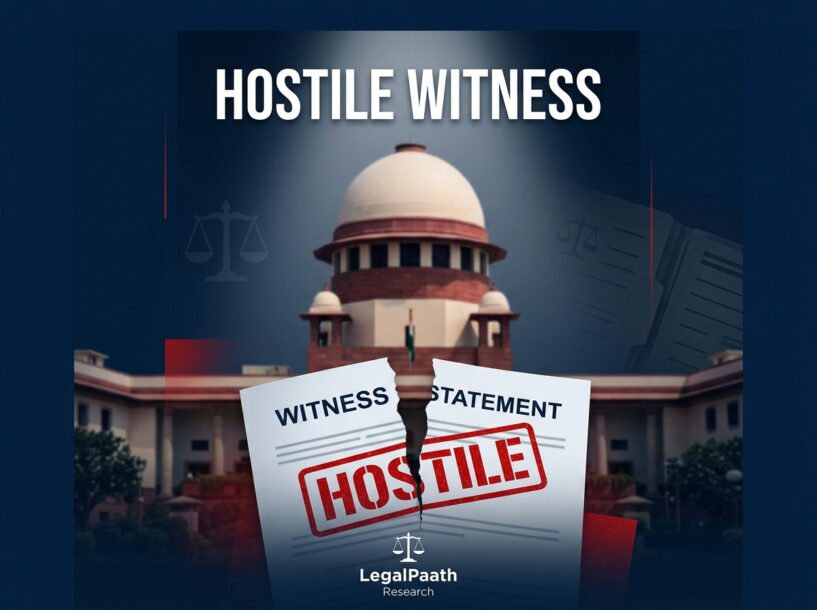
The Supreme Court clarified the law on hostile witness testimony and held that such evidence cannot be rejected completely. The Court stated that it is the duty of the court to identify and rely upon the credible portions of the testimony.
Factual Background
The case arose from a corruption allegation against a public officer. The complainant, a ration dealer, alleged that the accused demanded a bribe of ₹500 for performing an official duty. Acting on the complaint, the vigilance authorities arranged a trap and recovered the marked currency from the accused.
During trial, the complainant (PW1) turned hostile and gave inconsistent statements. Relying on this, the High Court acquitted the accused, holding that the demand of bribe was not proved.
Issue
The key issue before the Court was whether hostile witness testimony can be completely discarded, or whether courts can rely on its credible parts.
Court’s Analysis
The Supreme Court examined the entire evidence. It found that although the complainant gave inconsistent statements, he had admitted important facts such as filing the complaint, participating in trap proceedings, and confirming earlier statements.
The Court held that hostile witness testimony does not become useless. Courts must carefully examine the entire deposition and separate the truthful part from unreliable portions.
Relying on earlier precedents, the Court reiterated that evidence of a hostile witness can be accepted to the extent it is trustworthy and supported by other evidence.
Application to Present Case
The Court found that:
- The complaint was proved
- Trap proceedings were proved
- Recovery of money was established
- Independent witness supported the case
Even though PW1 turned hostile, the credible parts of his evidence supported the prosecution.
The Court also noted that the accused admitted acceptance of money but gave a false explanation. This further strengthened the prosecution case.
Error by High Court
The Supreme Court held that the High Court committed an error by discarding the entire testimony of the complainant. It failed to consider the creditworthy portions of the evidence.
The Court observed that such an approach is legally incorrect and leads to miscarriage of justice.
Decision
The Supreme Court allowed the appeal. It set aside the acquittal and restored the conviction recorded by the trial court.
Conclusion
This judgment strengthens the law of evidence. It makes clear that hostile witness testimony is not wholly unreliable. Courts must evaluate the entire evidence and rely on the parts that inspire confidence.